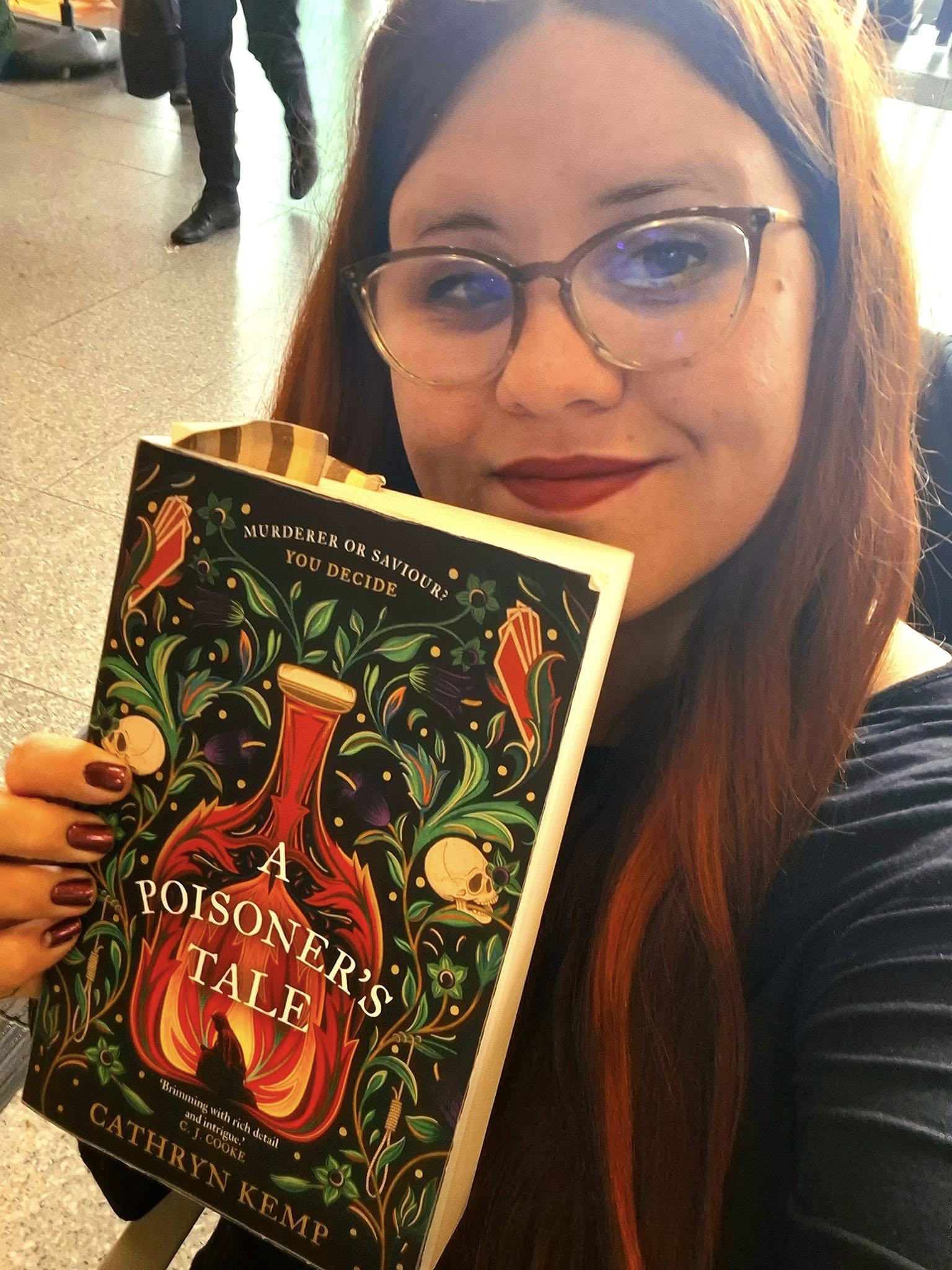
Is this my first negative witching review? Seems like it. At least, it is about a novel that makes me want to talk about a lot of issues.
I once promised myself to not ever write such a negative review, but to only use this new blog category to collect all the curious things I come across while doing my witching research. Since I have a deep respect for people who create, I had sworn to ignore those that do not fit my taste …
… but seriously, I need to write about certain tropes common in historical fiction! And reviewing the novel “The poisoner’s tale” by Catheryn Kemp is such a good opportunity to do just that.
Before we get started, there is a content warning! Since the novel deals with abuse, rape, miscarriages, abortion, and murder, skip to my conclusion at the bottom to avoid details concerning this! Also do this to avoid mild spoilers.
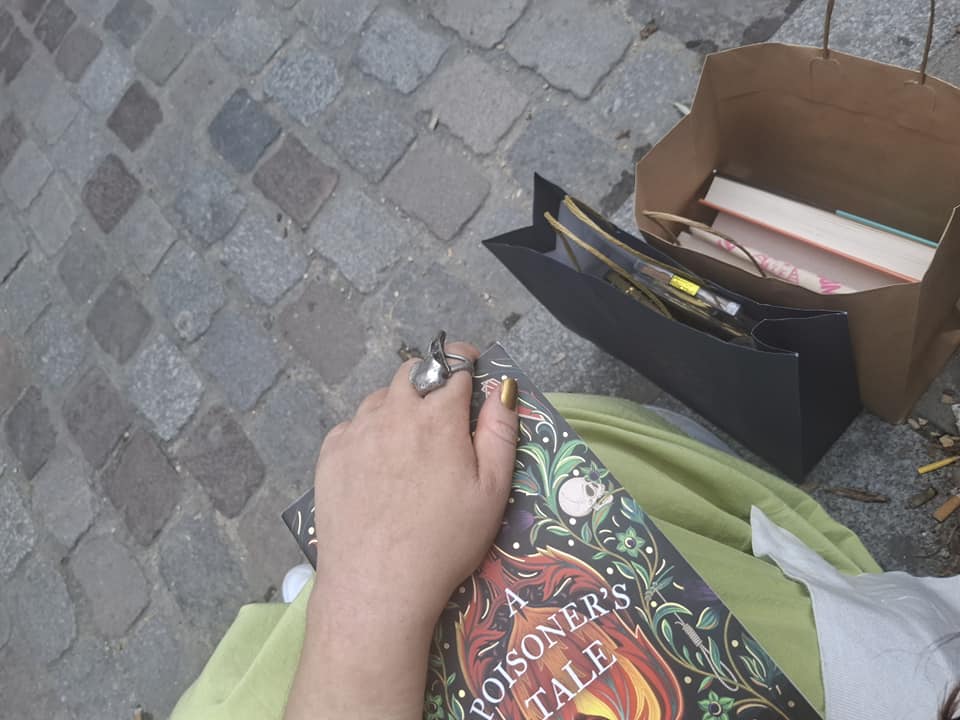
Here we go. Oh, and I bought the novel at a special bookstore! Last year, when I was in Paris, my friend took me to the bookstore “Shakespear and Company” at kilometer zero, in the heart of Paris, and despite a fire alarm disturbing our book hunt, I left more money there than I could have imagined.
The other books I bought are less troubling!
So, now we can start.
A brief summary
The novel is based on the historical case of the “Aqua Tofana”, a most likely arsenic solution used to murder men in Italy in the 17th century. In the novel, we follow the life of Guilia, the daughter of Teofania, who is loosely based on incidents believed to have surrounded several women over a few decades. We follow Guila as a teenager being introduced to her mother’s secret circle of women handing out poison to those women in need of it, meaning, those that without a murder cannot escape abuse. Wives, mistresses, prostitutes – any woman in the hands of the wrong man.
We also see Teofania executed eventually, and for the bigger part of the novel, Guilia is continuing her mother’s work. Together with other women having suffered in silence in the city of Rome, they hand out poison to murder abusive husbands and lovers … or the lovers of girls who accidentally became pregnant in a secret affair? The husband of a noble woman wishing to marry someone else? Out of empathy for the women? Or out of hate for men?
The biography of a murderer?
Guilia grows up in Palermo with her mother, who is a former prostitute, and her stepfather, who is abusing her. Very early in the novel, we are almost casually introduced to the fact that the stepfather is making her uncomfortable with his attention, and just as casually we find ourselves in a brutal rape, which isn’t even the first one our main character has to endure.
It is described as the status quo, the way things are, with no respect for the pain and suffering inflicted. Maybe this was the writer’s attempt to imagine the mental state of someone used to abuse, but I think it failed. As someone who survived similar things, I felt like these moments were deeply misunderstood.
The novel continues to tell us that Teofania, Guilia’s mother, has apparently been expecting this for a while. This was her only reaction. No shock, no clear sign of empathy for her 14-year-old daughter. I’m not saying these mothers do not exist. I simply feel once again as if the writer misunderstood a dynamic here. Does Teofania have empathy for women?
Soon after, Guilia is pregnant. Now, just imagine being 14 years old and pregnant from your stepfather raping you. Or even better, imagine that happening to your own daughter. How would you react? Would you force her to have an abortion? Probably not the worst idea, if she agrees. Would you run away with her? Hide her from the men doing that to her? Risk all of your wealth and safety for the chance of saving her?
I would wish for my mother to do just that.
And so did Guila.
But her mother, after first agreeing to run away with her, lured into the arms of her secret women, urging her to get the abortion Guilia did not want.
All of this was leading up to the moment that perfectly describes my problem I have with this novel.
A special bond between women
As Guilia realizes that her mother is not planning on running away with her, but rather brought her to people preparing her abortion, she describes a special kind of bond that can only exist between women.
Not between men and women, not between men and men. Only women.
So, what kind of bond is this? Is this the bond she has with her mother expecting her to be brutally raped? Is it the bond between her and the mother who does not want to flee with her, but rather trick into the abortion she didn’t want? The bond between the other women and her mother, murdering husbands regularly?
What is this kind of bond?
I have never understood this kind of bond, and I have stumbled across it in especially historical fiction a lot. The bond between women accepting abuse as their only option. The bond between women telling each other off for feeling pain. The bond between women accepting their own existence as asexual, aromantic, because that would all involve men. The bond between women, in my opinion, is very toxic when executed like this.
I have been researching biographies of all kinds of weird people from the early modern age. I have found normal, analphabetic women fleeing from unwanted marriages and abusive husbands. I have found women who fought to own their businesses, switching kingdoms in the process. I have found queer people, trans people.
What I want to say is that I don’t believe this image of women having no other chance than being the victim. There of course were some who thought this way, and I am not saying that this is entirely unrealistic.
It’s just not empowering at all. No matter how much abuse I suffered (and I can authentically say this), I would always recognize pain of others’ and would love to avoid it. Abuse is never normal, never daily business. And after reading through all kinds of historical record, I am convinced that even medieval people thought that way. It still happened, just as it does today.
But this bond of women, working in the darkness, while accepting abuse as their daily business – it is more than troubling.
Many more murders
As I already said, this first thought was the troubling childhood of Guila, our main character, and main murderer.
She kept her unborn child, watched her mother eventually being executed as a murderer, and moved her work to Rome, where she continued.
The novel tries to show a transition from earlier cases, where the women is more clearly innocent and traumatized when asking for the aqua, to later cases where Guilia more and more agrees to murder men that are not abusive, but simply unlucky, but I don’t see this transition as clearly, since I have been repelled by this women-bond right from the start.
A question the novel tries to ask is that of guild. Is a woman guilty for murdering her abusive husband? Is Guilia guilty for murdering men, after what one of them did to her as a child?
This is being described as a complex question, one that leads into a gray area – and I don’t see it that way at all. I think they are all guilty. They murder men without even knowing for sure what actually happened, and they lose control of their own murderous doing more and more. This is not a dilemma, not a gray area. Murder is wrong.
If Guilia, would have murdered her own stepfather, I would have understood this question, but the way it is asked, I feel, once again, as if it misses the point.
One dimensional men
Another thing that bothers me is how men are portrayed in this novel. Call me a “pick me” girl if you wish, but here me out! We meet abusive husbands, lustful priests, and even follow the Pope Alexander the 7th through weird fantasies that feel awfully far stretched. There is not a single relatable male character, not a single man with empathy, with emotions, with love, or at least a genuine interest in a woman.
Don’t get me wrong here, it is alright to show levels of abuse … but this went too far. There are others. We have historical records of love stories through all ages. In medieval times, Hildegard of Bingen wrote down the description of an orgasm a simple woman gave her when asked why she was pregnant again. Telling the biography of a woman murdering men and not in one scene confronting her with a man shaking up her expectation is odd. At the very end of the novel, we even find out that Guilia despite her trauma had had lovers through the years, and that she never learned to distinguish the difference between intimacy and threat, and seeing her character in those moments would have given it so much more dimension.
Instead, we suddenly have snippets told from the Pope himself, who apparently has terrible mommy-issues, and becomes obsessed with lustful thoughts for Guilia … why ever. I didn’t need that.
Where they witches?
The witch hunts did not happen because all the popes and priests were sexually frustrated women haters. Priests had affairs despite celibacy on mass, and also, the Vatican was not in charge of the famous witch hunts. They were actually against the way it became a mass phenomenon in Europe, but it was outside of their legal powers to prevent them.
Still, the novel chooses citations from “Malleus Maleficarum” and calls the murderers witches. This is historically such a crime, I would need to write an own post on this.
“Malleus Maleficarum” is a book written on witches by a munch in the 15th century, and I have already wrote a brief post about this. The one who wrote it was almost excommunicated, because the church did not agree with his statements, and since I have worked through his book, I can tell you that the kind of threat he saw in witches was of another, spiritual, magical nature.
They were not witches, they were simply murderers with a good deal of trauma. Even in a medieval, early modern understanding. Even in a legal understanding of their time. Please research the time you write in!
Conclusion
This novel was a wide ride! I did not enjoy it, but also upset me so much, I had to finish it. Certain tropes, such as the bond between women in abusive settings, are overused especially in historical fiction, and I think the novel did not achieve to ask the moral, ethical, and philosophical questions it tried to. Historically, a lot of details are so far stretched and problematic, I’d wish it came with a historical comment by someone competent. Between a deep misunderstanding of the witch hunts, the role of the church, and the one-dimensional characters taking the dilemma from the reader, I would not necessarily recommend reading this novel at all.
 Mistress witch writes