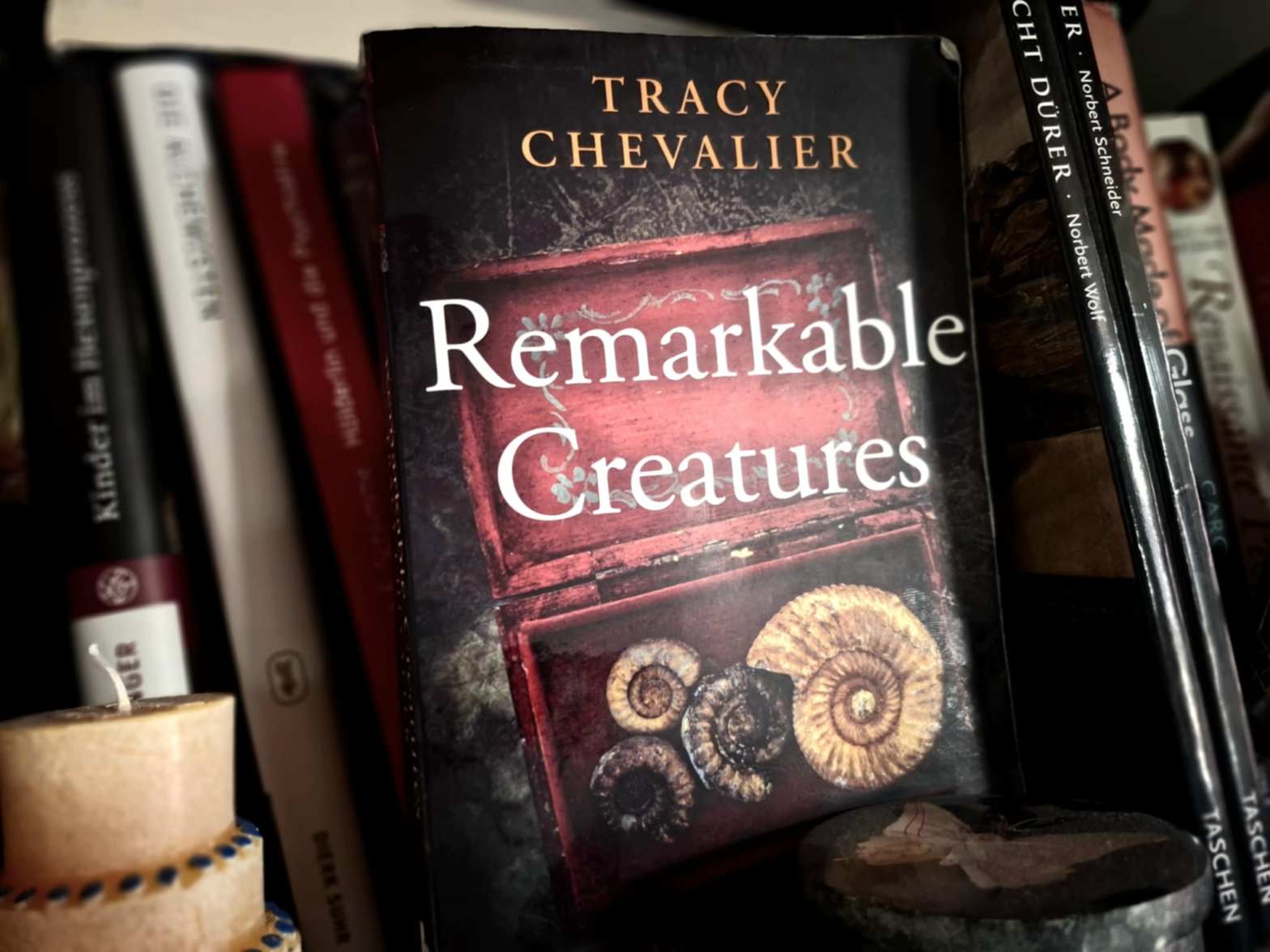
This time, I am reviewing a novel that combines my two passions: The history of science, and well, novel writing. It is a wonderfully crafted piece of historical fiction!
This one is about the novel “Remarkable Creatures” by Tracy Chevalier.
Set in the early 19th century, this novel is about two women looking for fossils in a world that is only slowly beginning to understand itself. The novel provides insight into the scientific community and its consent and debates of a time before a theory of evolution was developed and discussed, before the age of the earth was known. It is fascinating to follow characters through the terrifying and yet wonderful experience of discovering the remains of a species not yet known when it was unimaginable that species come and go and change over time. But the most fascinating aspect of the novel is the two characters through whose eyes we are experiencing this world: Two women in a time when science was officially in the hand of men.
We follow the two main characters, Elizabeth Philpot and Mary Anning, living at the Jurassic Coast near Lyme Regis while searching the shores. To anyone interested in the field, the two names are well known. Mary Anning by now has her own showcase at the Natural History Museum in London. She, for example, was the first to correctly put together a Ichthyosaur and recognize it as a huge reptile. But as the reader of the novel, we are not just invited to admire the wonders of the natural world and earth’s history – we also experience the price these women pay for their work in a field of men. While Elizabeth Philpot comes from a family of unmarried sisters that (economically) missed their chance of finding a husband in their early 20s, we also watch a much younger Mary Anning grow into a girl and a woman that does not have a place in society at all. In fact, these parts of the novel are so raw and authentically written, I sometimes wanted to throw the book against the wall, because it drove me all so mad.
Still, I think this is the greatest compliment to the novel. It captures these painfully unjust stories besides all the scientific wonders surrounding them.
In the postscript, the author describes the life of Mary Anning as uneventful, and the authors task as finding a narrative to make it accessible for an audience.
In my opinion, this worked out well. There is one scene, and this is the only part of my review that gives away a piece of the plot, where I think the author found a narrative that was so beautiful and simple, it surprised me. It’s the only intimate scene between a man and one of these weird women that will occur throughout the whole novel. We follow these young women growing up and growing old, and we wait for things to never happen. In this one scene, however, one of them learns about a “light that comes from within”. And shortly afterwards, we learn a new justification of why we talk about kisses that never happened over and over again, although we know that we cannot relive them.
These very few but very well-written moments scattered across a world struggling to understand itself in the light of new, terrifying, conflicting evidence is what made this novel a wonderful peace of historical fiction that I finished within just a very few reading sessions. I hope you’ll enjoy it too!
 Mistress witch writes