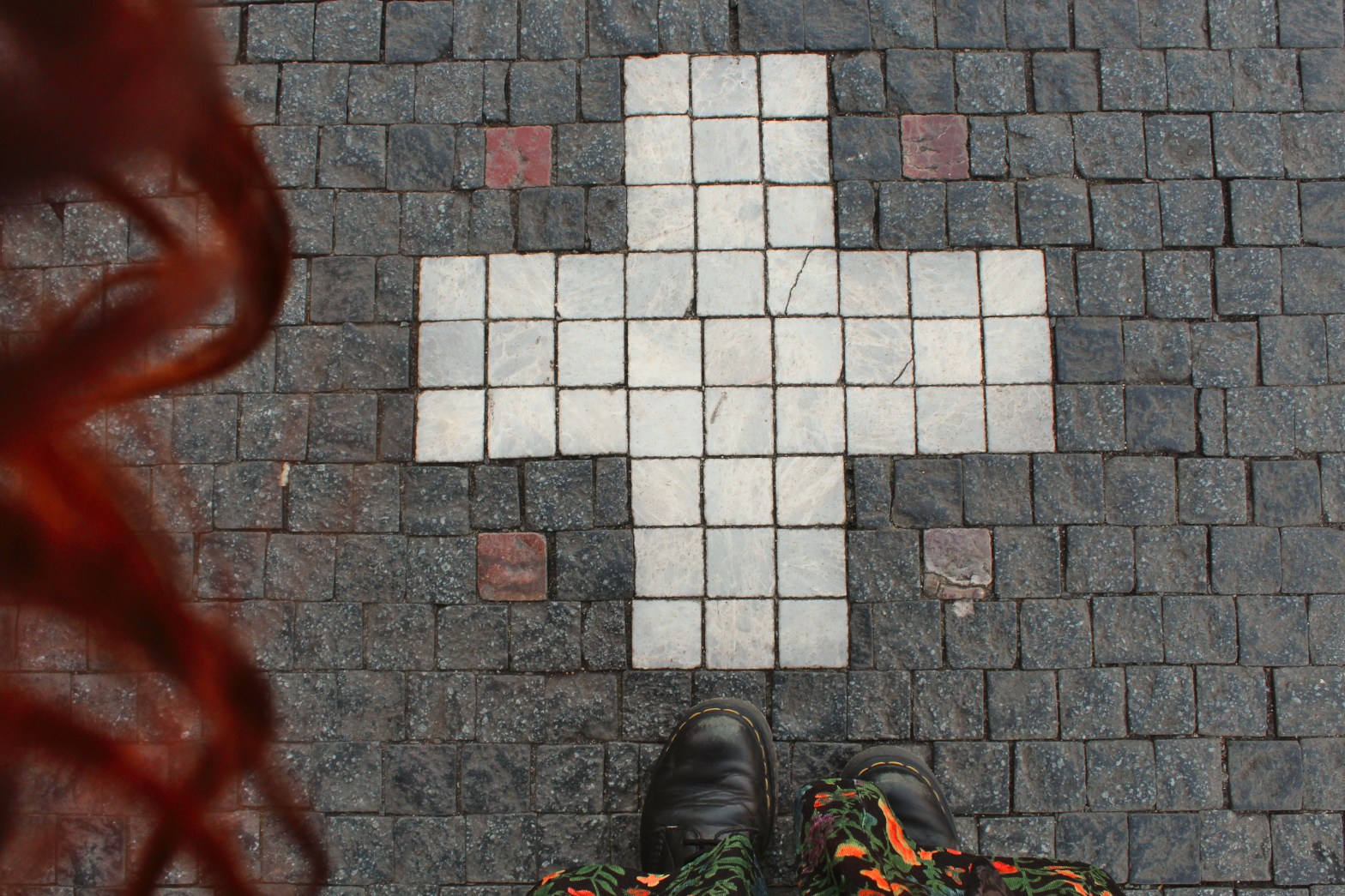
“This place is so haunted”, my witch giggles over my shoulder.
I took us to a place where for the both of us history becomes very much alive and reminds us of how fragile and thin skinned we are, and how exposed we are to history’s tales.
A trip to Prague
My witch and I visited Prague together. I have always loved walking through those historic cobbled streets that sometimes felt as if I’d found the historic heart of Europe, but this is a bold statement and probably the topic for another blog post.
This one is about me and my witch visiting the white crosses in the heart of the city. Easily overlooked by visitors (including me when I first came to this city at the age of 17), this place is meant to remind of the chaos Europe experienced in the early modern era.
28 crosses
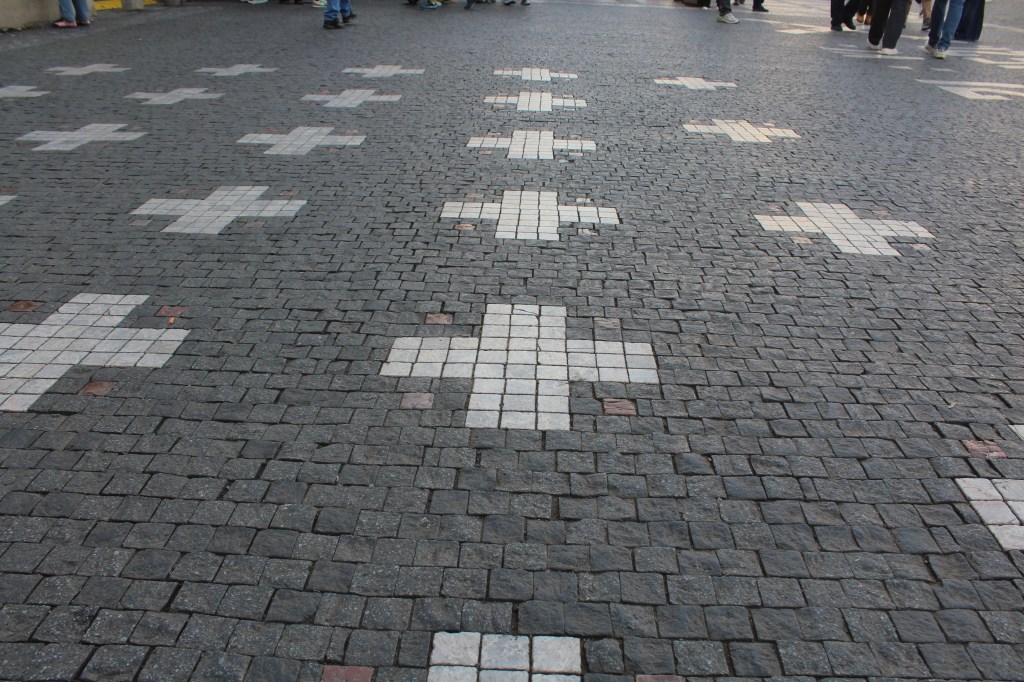
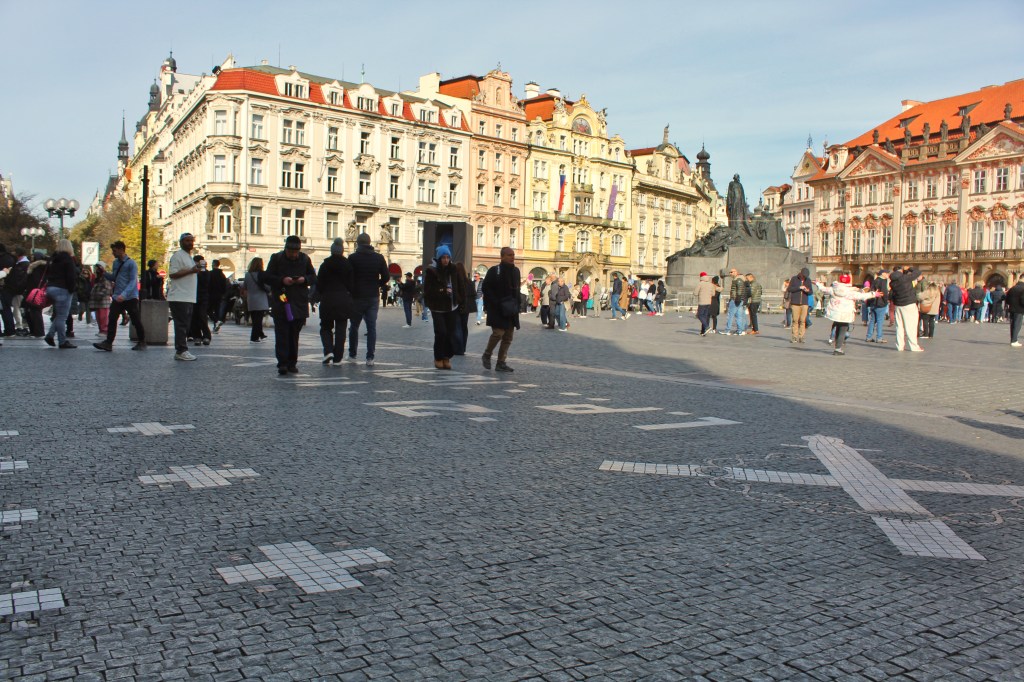
Next to the town hall with its famous astronomic clock (that truly is beautiful to watch), there are 28 white crosses put into the pattern of the pavement. To be honest, the first time I walked above them, I did not even register that this might be a monument of some kind, because the pavement across the city often displays beautiful patterns.
The reason for this one, however, is given away by the number 1621 being included, which is the year of the executions this cross reminds of.
The readers who have been following my blog regularly will have noticed that I keep coming back to this early phase of the 17th century. My witch and I already explored together what it was like to be a young woman in 1618. It was a year that saw the tension between the Catholics and the Protestants turn into a seemingly local conflict troubling the eastern border of the Holy Roman Empire, the kingdom of Bohemia.

The protestants threw three Catholics belonging to the King’s administration out of a window in Prague, which was the start of a spiral of violence that would take new shapes for 30 years to come, until devastation was big enough to negotiate a solution. Sounds like a bad joke, right? Yea, my witch thought the same. For more, read this older blog post.
The white crosses send chills down my neck each time I visit them.
“They are a reminder that the war could have ended right here, right?”, my witch giggles over my shoulder, and I have to agree with her.
Not just any war
Something remarkable about the 30-years-war, that is often overlooked between dying civilians and burning landscapes, is the many moments in which it seemed to be over, only to burn up again in unforeseen constellations and intensity.
After the conflict between the Catholics and the Protestants had become violent, the Protestants were gathering soldiers and alleys wherever they could, while the Holy Roman Empire tried to keep its centuries old order in place. We can imagine this as a time of unrest all over the Empire in the middle of Europe. Young men were leaving their homes to join the one of the other sides, while armies were appearing seemingly out of nowhere and cities were besieged. The Protestants tried to seek support from outside the empire, even had a protestant king with support of the English crown take over Bohemia for a short while, but none of their plans seemed to fully workout. When reading their attempts to gather forces in 1619, I always feel as if the war could have ended in this early phase, but it did not.
It all escalated in 1620 with the Battle of the White Mountain, the first big battle of the long war to come. West of the castle of Prague, the protestants were beaten by the Catholics. Many protestants died during the battle, others fled the empire, while even others were taken as prisoners.
This is what the white crosses* are a reminder of.
In 1621, 27 protestants, popular leaders of theirs among them, were publicly executed in the middle of Prague. Some had their tongues cut off. Some heads were left on display for the next winter, to remind of the Catholic Habsburg Power.
This could have been it. This could have been the end. Germany and many of the neighbouring regions could have just stayed catholic for good.
But it did not.
One important aspect are those protestants that escaped death and imprisonment at the white mountain, and left the empire to look for help elsewhere. Another reason is another parallel religious war taking place between the Spanish Habsburgs and the Netherlands, the 80-Years-war.
A very international war
For the Holy Roman Empire this development meant that forces from the outside were now entering the conflict, and as you know from more recent wars: This kind of international conflicts tend to become messy and last for a while. Some sources actually call this the closest thing to a world war the world had seen so far, since through the involvement of the Ottomans even Asian people fought in Europe.
The most important military Newcomer after the Protestants defeat at the White Mountain, however, was Sweden. Supporting the Protestants, their military forces would keep the war hot all over the Empire for the next decade, hoping for the Habsburgs to fall, and Protestants to take over the Empire?
The outcome of these decades of war shaped the political landscape in more ways than I can explain here. Just to give one example: I grew up in Hamburg, were traditionally people are protestant. When I moved to Bochum, the catholic holidays surprised me for several years. These traditions are a result of that war.
So, what do the white crosses stand for nowadays?
“He probably died here”, my witch whispers over my shoulder, and I have to ssshhh her. Let’s focus for a moment. We can get drunk later. Prague has wonderful beer.
But yes, they stand for a war that could have been over, but escalated into a new level of unforeseen chaos. And also, they stand for people dying for something they believed in, however absurd a religious war might seem to us today. But at least we have a place to visit and remember, and learn about a story that may seem distant and tough to understand for us today.
It’s important to keep our stories alive.
History becomes very much alive right there. Just as my witch says: This place is so haunted.
*Originally, the pattern only showed 27 crosses. Number 28 was added for Martin Fruwein of Podolí, who committed Suicide before his execition.
https://prague.eu/en/objevujte/28-crosses/
https://www.ourbeautifulprague.com/27-executed-28-crosses-and-one-pardon-a-second-before-death/
https://www.britannica.com/event/Battle-of-White-Mountain
https://www.dw.com/en/the-thirty-years-war-a-battle-over-religion-power-and-territory/g-43864921
 Mistress witch writes