
If you belong to those constantly caught between wonder and worry about the fragility and persistence of the human body, I may have the perfect book for you! This witching review is on a rather personal piece of non-fiction:
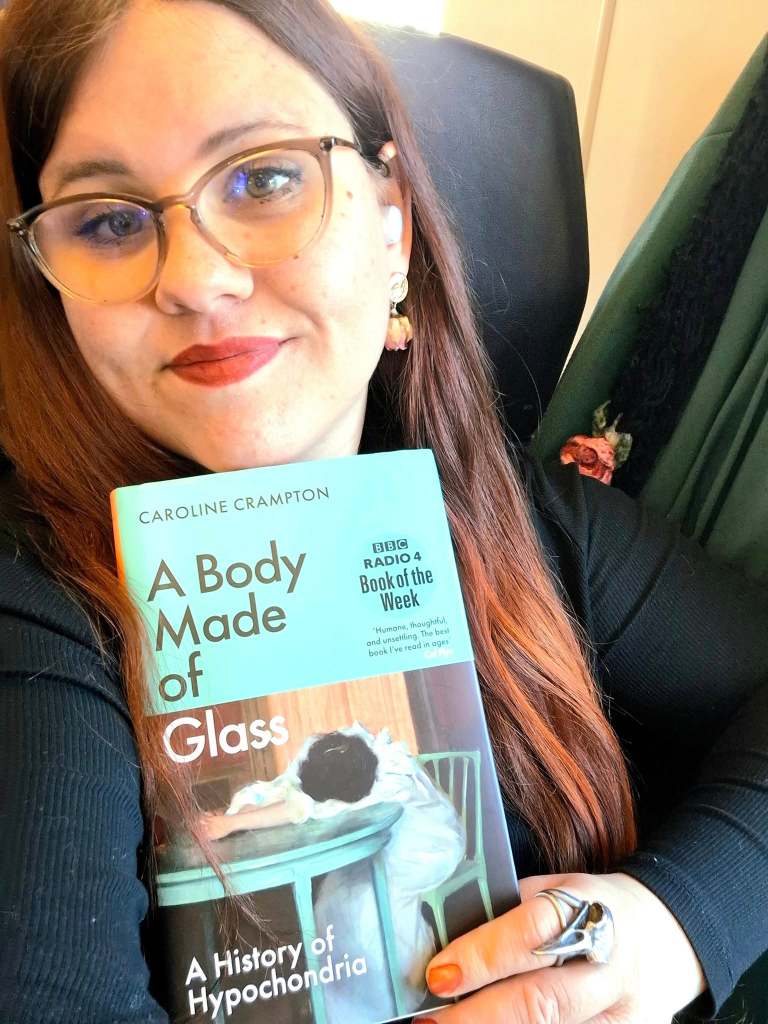
“A Body made of glass – A History of Hypochondria” by Caroline Crampton

When I found that book on a much too expensive book buying afternoon on a terribly expensive Paris trip, I had to buy it for several reasons. I hoped to learn something about what health and illness mean by exploring what symptoms were grouped into which category throughout history, and also, the cover showing a painting of a woman suffering beautifully in a nice dress was just the vibe I needed when I could not avoid my doctors any longer. And let me tell you, it was a reading experience you won’t make too often! It was not just knowledgeable, but also highly personal, offering unique insights and context.
So, let me first tease the science part you can learn something about in this book. You will for example learn where the word “Hypochondria” came from, and how it traces back through medieval medicine to antiquity, and connects concepts through all of these centuries in between. You will also receive insights on the theory of humors that shaped our understanding of body and health until roughly 200 years ago. Since my degree has in the meantime equippedme with some deeper understanding regarding the history of science, especially the life sciences, I can confirm that this aspect of the book was researched with a lot of care and quality!
But that is not the only reason to read this book. I think the author does two things that make it such an important reading experience.
First of all, she dives deeper into cultural history surrounding the concept of health and disease, the fear of losing health, and how it was interpreted culturally in regard to our scientific understanding at the time. From Molière to the “Seinfield”-series, she draws a connection between the (historical) science part and the cultural narrative. She also sheds light on diagnosis we have accepted as physical today that were simply blamed on the mind in the past, highlighting historical figures struggling with things like asthma.
The second reason why you have to read this might be the reason for the authors ability to find these connections in the first place. The book was not just written by someone with a nerdy interest of some kind. No. The book was written by someone living with Hypochondria, with the constant fear of becoming seriously ill, because it had happened once. Throughout the book, we learn about her fighting cancer in her late teens, and about the way in which this shaped her relationship to her body. Besides detailed insights into chemo and stem cell therapy, we also learn about her finding tumors years later that no doctor can confirm. I marked a paragraph where she had a panic attack years after being proclaimed healthy, because she suddenly had a bunch of her own hair in her hand. She called a health hotline in panic, and almost was picked up by an ambulance when she confirmed that she was bleeding, because her brain had forgotten for a second that bleeding during periods was normal.
It is this personal endeavour that makes this well-researched and deeply comprehensive non-fiction-book so wonderful to read. It explores all aspects of struggling with understanding when this body is actually healthy, and how we can tell. Towards the end, I felt that it got a bit long, since the health struggles she gets herself into without ever coming to a result do not seem to end, and she eventually addresses this.
The problem with defining health and disease as well physical and mental illness is that there is no way to be absolutely sure. Our scientific knowledge is constantly changing. We constantly have to work with new definitions, guidelines, lab tests, as well as the possibility for a tiny tumor cell to grow out of control at any moment.
If you are willing to explore this very historical struggle of having a fucking fragile body, or if you suffer from this and need to laugh about yourself, or are simply interested in ths, I deeply recommend reading this. But beware! It is not for the faint-hearted. I myself have often struggled with these anxieties due to another kind of trauma, and there were times when I wanted to throw that book into the wall! In the end, however, I’m glad I finished it and has a special place in my damaged heart, and my bookshelf.
 Mistress witch writes