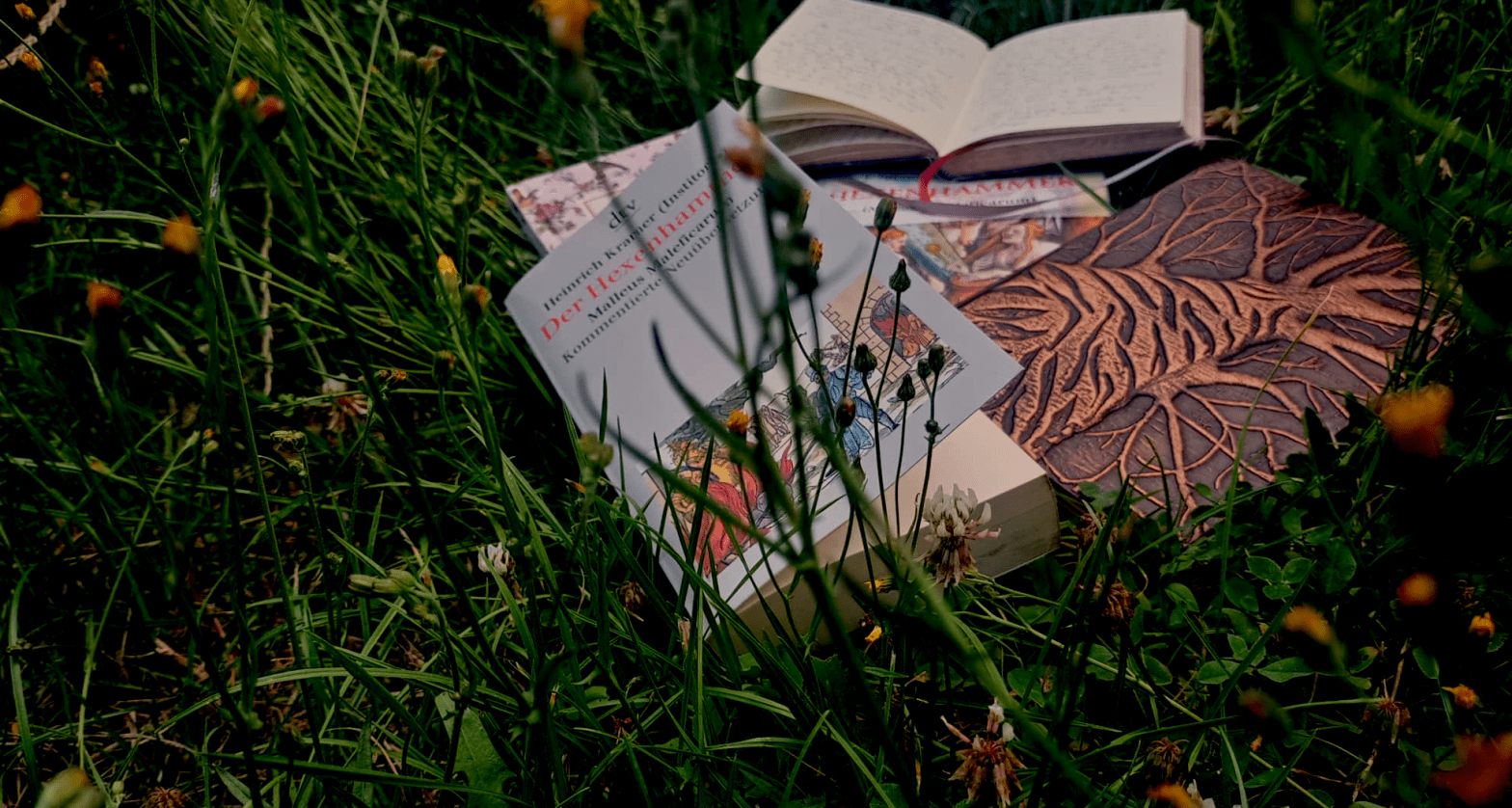
Today I‘m wondering how it all started!
Who is the father of the witching myth as it developed in early modern Europe?
Who the hell was the person that wrote the manifest starting the witch hunts in Europe? Who would waste their time scribbling together a piece such as „Malleus Maleficarum“, only to be responsible for thousands of deaths?
„Oh yes!“, my witch giggles. „Tell me about Daddy!“
It is a fact that the witch hunts accelarated and developed their well known procedure after this manifest was published in 1485. It is also important to notice that the book does not completely picture the reality on how the church itself dealt with witches. Each trial to happen within the next 300 years was discussed by various people and institutions and while people living in terror often yearned for a witch to burn, the church and the popes were much more careful. But that is the issue for an own blog post.
Important here: The book founded an ideology, a believe in a myth with severe consequences shaping the history of and the life in Europe.
So, who was the person writing it?
„The asshole“, my witch spit out, while enjoying an Oat milk Latte at our coffee place in the train station. „The misogynist. The frustrated monk. Tell me more about Daddy!“ And the smooth Jazz Music swallowed the next wave of giggles.
God, life felt good today.
The writers of „Malleus Maleficarum“ in fact was a Monk. His name was Heinrich Kramer, or, as not unusual for the 15th century, also known by the Latin name „Henricus Institoris“. He was born in 1430 in Schlettstadt (today Sélestat in France), died 1505 in Bohemia, and joined the Dominican monks to study Latin and Philosphy. Some sources stated that this was his best choice as the child of a poor family. This let to a remarkable career, since he traveled to Rome, where he finished his doctoral degree, and would later in Germany even work for the Inquisition.
A successful career for late medieval times!
„So, who would he be today?“, my witch asks „That person at the bank that tried to sell us another insurance for shit to never happen?“
„More like the Professor for Literarue that does not believe in social injustice, because his life went lucky and who recently protested against wearing masks in a pandemic“, I tell her and have a very arrogant person from my past in mind.
Important steps in this career also were his job in taking the confession of a Bishop to be executed in a trial, and his writings against church critics, heathens and the Jewish population. He was a tough one!
So, where did it all go wrong?
Well, first of all: Institoris was convinced of the witching myth, as I described very detailed on this blog, to be real and he wanted to clean up any doubt people could have about it.
He wanted to convince the world that there was a secret organization of women making deals and having sex with the devil, eating babies and doing damage to the world!
Working for the inquisition, he was not at all supported. He even got fired in Brixen, and described and childish and insane. It were these setbacks, that lead to him writing his manifest, Malleus Maleficarum. A book that would become a bestseller long after his death, in the late 16th and early 17th century. Some editions have a second name, Jakob Sprenger, as a writer on their front, but this person most likely did not help writing this book. He was often mentioned by Institoris in his book to convince his readers of his authority. Sprenger himself was not an extremist and not working with Institoris.
The manifest to start the witch hunts and influence the perception of women for very long was written by an extremist monk who used an impressive career to convince the world of a conspiracy theory he had fallen for! Isn‘t that nice?
Also, wherever in history you are, it is never a good idea to let a man with wild ideas that recently got fired, or expelled, or locked up, write a book he would later hand around! Not just in the 20th century, that promises disaster.
„I need more sugar in this“, my witch sighed.
Behringer, W., Jerouschek, G., Kramer, H, und Tschacher, W. (2000). Der Hexenhammer. Dtv: München
Fritz, A. (2022). Hintergründe. Online: https://www.astrid-fritz.de/hintergrundinformation_hexenjaeger.html
Behringer, W. (2022). Jakob Sprenger. Online: https://www.deutsche-biographie.de/sfz80845.html
Merzbacher, F. (2022). Heinrich Institoris. Online: https://www.deutsche-biographie.de/sfz36444.html#ndbcontent

I wish I’d told you all my stories.
I want to tell you all my storiesIt’s not that they would changeIt’s just that I would likeTo see themFormA new expressionOn your face I need to tell you all my storiesI am not sureIf they makeSenseThe way I thoughtThey do. I will tell you all my storiesThey frighten meI’m sure you won’t endureI see…


Dealing with darkness in writing
This spring afternoon is glowing pink and tastes like strong tea. It feels much too familiar, and I begin to open up.I feel far away from myself as I start to talk, to babble on about my novel. About all the things I’ve been reading about in the past 5 years. About the 17th century,…

Radical witching novel rewrites at 4 AM!
I wore the same night dress my witch used to wear to get drunk on my windowsill, when I suddenly had an idea at 4 AM. Great ideas always happen at 4 AM, remember? This one however, kept me awake for at least a week, debating it back and forth. At some point my witch…
 Mistress witch writes
Unfortunately, Dominican radical figures like Kramer are all too common in the Christian realm. He had counterparts in other European nations: Torquemada in Spain, and Savonarola in Italy.
Funny thing that the Dominicans — with their firebrand preaching — were also one of the most active religious orders during the Spanish colonial period in the Philippines.
(Thank you for following The Monching’s Guide, by the way! Couldn’t comment on your About page, so I’ll just leave this here if you don’t mind.)
LikeLiked by 1 person
Thanks a lot for reading!
It is interesting to follow these figures and to look deeper into past discussions, because christian figures are so very different through the centuries.
LikeLiked by 1 person