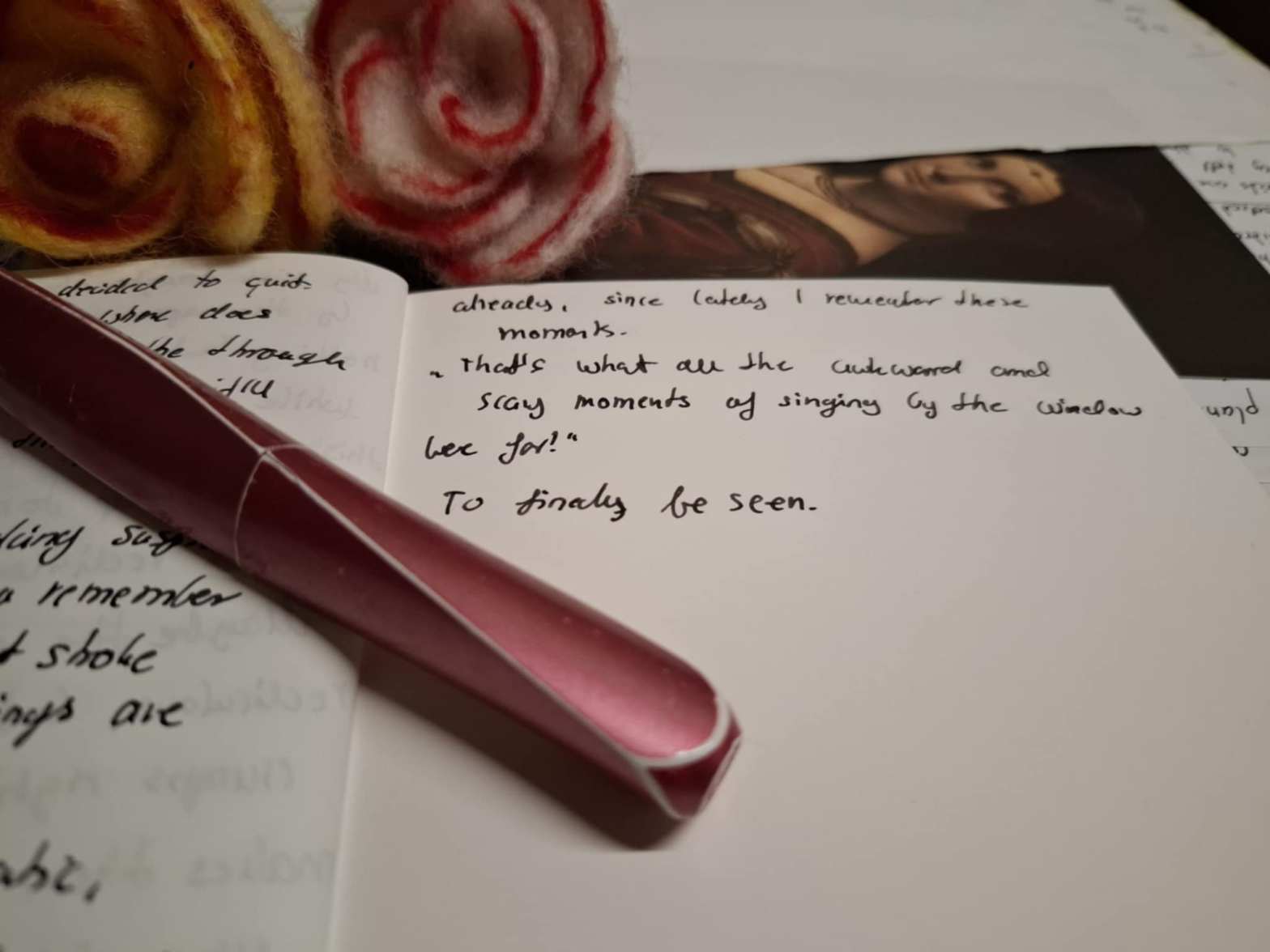
It is an early afternoon, and I am alone in a brutalist library, having my witch on my shoulder. Together, we are cross-reading the original court files of a witch hunt in Cologne in 1629, and while we burn for the insights the book has to offer, I am shaking and tears are still glowing in my face. But let me start at the beginning.
Do you still remember my witching tales? Weird flash fiction that was somewhat inspired by historical concepts, and often ended in flames and choking each other? Do you miss those? Yes, me too.
Recently, I have made an experience that has me struggle in writing those.
I am about to finish my master’s degree in “History, Philosophy, and Culture of Science”. For the past 18 months, I have been studying the history of science, theories on how to define knowledge and science, and all with the perspective that I want to keep up my museum work to preserve these things for the future. It was a wonderful time, and a lot of things I read have been inspiring my writing!
My degree gave me the opportunity to work across disciplines, based on those I studied before. As a science and society (weird subject in German schools with a bit of history, politics etc.) teacher, I could explore the early modern age, and the understand the changes that happened in my favourite chapter of European history a bit better. It’s the time my witching novel is set in, after all!
Since I’ve had this historic motivation right from the start, I at some point wanted to take classes given by normal historians. Not by scientists with an interest in history of science, not by philosophers of science! I wanted to work with historians.
And well. That was a mistake with long-lasting consequences.
Now, I don’t want to insult historians. I love the work they do, I read the stuff they publish very regularly.
But from this very personal encounter, I still have to recover, and I’m working on it.
So, the only cultural historian of the early modern period at my university gave a class on the history of bodies. Body conceptions, understanding history through understanding dealing with bodies. She had done research on witch hunts, on forensic medicine in medieval times – it sounded like a match. The class was even registered by her for my master’s program, and when I asked her if I could join although I was no historian, she was very excited about it. Finally she had someone from my master’s degree in her class!
Long story short: it ended in a big mess. I cried a lot in the end.
I worked through that class, that had a lot more papers to read than any philosophy class I had ever attended, but I managed. I learned to read old German alphabets for the readings, and I gave a presentation about the changing conceptions of bodies in the early modern medicine, that was accepted as good.
When discussing a term paper to write, I stuck with the topic of illness and health in the early modern days. What was an ill body? How was it treated. And I found a lot of literature about court files where illness, disability, epidemics and all of these things suddenly mattered. My topic was accepted, but, typically for the professor, she suddenly began teasing me for having an interest in all of these conceptional aspects. When, for example, I talked about the humoral component of a certain common treatment, she became rather harsh and told me that dealing with these concepts had nothing to do with humans.
I was rather confused by that statement, but let it be. How a doctor treats a common disease, and when the disease then suddenly appears in court files has a lot to do with how humans live or, well, die. I would think so at least. But I also saw and heard that she interrupted other students with confusing and contradictory statements as well. She was the typical successful Boomer. Rather harsh, loud, and dominant. I convinced myself to ignore it. That was a mistake.

We agreed on a topic concerning these witch trials, and soon into researching and writing the paper, I had a few questions, so I contacted her again (as agreed upon). She knew that I was not a historian in the common sense, so I had rather specific questions about how to work with a certain kind of historical source. A few rather technical yes or no questions.
That conversation however turned out to be the most challenging one in my whole master’s degree.
She did not understand how I had a question about using the source. Everybody knew this! I reminded her that I was not a historian.
Then, she snatched a piece of paper from my hand. That piece of paper included all of the literature and sources which I had planned on reading for this paper. It had more than 100 titles, some crossed off the list after reading them, some with other notes taken on the site. It was clearly just a personal work sheet, not anything I’d ever hand in.
She suddenly critised me for reading a colleague she personally disliked. She also teased me for some titles I had included at first but had already crossed off. I should have known better. “Did you use a software on this?” “Yes.”
I am a research assistant. I had learned to use software in longer papers to stay organized from the professor I work for.
“Anyone taking their own work seriously does not ever use software.”
Great, I’d better tell my boss.
She went on explaining to me that I was unable to understand what history was and that I was not asking questions about humans. Humans did not care about what their doctors actually did to them or talked about. Humans have nothing to do with atoms … Atoms? Yes, I was wondering how atoms entered the discussion about the court files as well. Did you see any atoms enter? Oh wait. We are all made of atoms. So, why should they matter?!
I assumed that she remembered my background as a science teacher and was teasing me again. Later, I saw that one of the papers on my reading list had the term “atomism” in the title.
Atomism in this context however is not about atoms, and not about modern natural science. In late medieval days, it was referring to a philosophical school of thought from antiquity, dealing with questions such as what kind of substance the soul was made of.
Either she did not know or did not care.
She went on giving a long speech that did not leave any room for me to defend myself. She said that in general the history of science must justify if it is worth any funding at all, because it does not matter to humans at all. “All of these intellectual things do not interest the farmer next door and are therefore not relevant for history”, she said. She also mentioned her father being a electrician a few times, as if it mattered.
Now, I have an issue with authority, so I did not cope well. I fled the room, and cried for a few days. Yes, that’s me.
But also, I felt mistreated.
I think that intellectual concepts matter for the daily life of people, even if not all of them are constantly aware of it. When I am ill, or when a child in my family is born, I will go and seek medical help, probably in a monastery nearby, and their conception of the world has an impact on me. Same goes for a court of law. What if suddenly I am accused of being a witch because some weird treatment revealed that my body humors have been corrupted?
I still think my interest is valid.
In the end, I got out of writing the paper. My professors decided that it was pointless for my degree to deal with that, and so I wrote a paper in another class. Me, the girl who has an issue with authority, had three professors fighting over herself.
It was a my personal nightmare.
But I got out of it. I even found new motivation for why the history of science matters, even to humans! I will write about that soon.
The academic experience is diverse, is what a colleague of mine has said to stories like this, and I think that is the most imlortant thing to remember. I love learning, questioning, and exploring the world like this, but it also means running into these walls by people seeing the world so very differently.
But picking up historical sources is something I struggle with ever since taking that class and having it end in that discussion. I still need some time, I guess. My witch is suspiciously quiet about this as well. We are simply coping!


It sounds like you met someone with an inflated sense of their own importance, an inability to show any respect, and likely a fear of their own inadequacy. She’s a bully and best avoided.
LikeLiked by 1 person
That is a good summary. It was a tough lesson learned.
LikeLiked by 1 person